
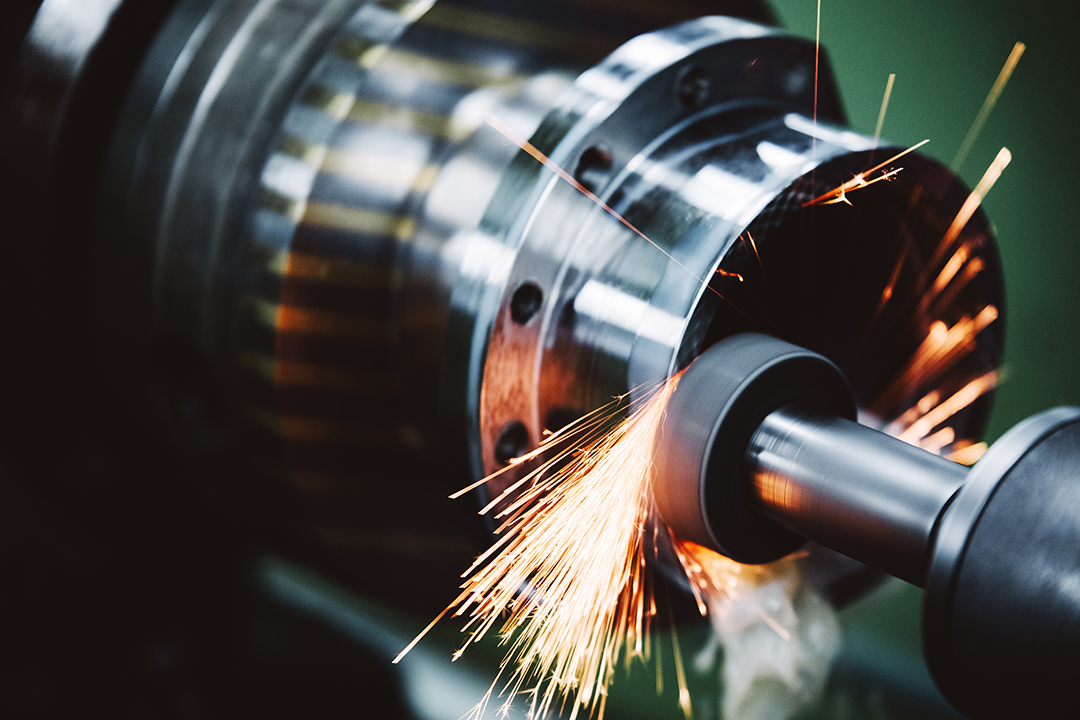
Grinding is the operation that takes a machined part from close to correct and makes it exactly right. Milling and turning get a component to near-final dimensions. Grinding closes the gap between “within general tolerance” and “within the tolerance that actually matters for this application.” For precision buyers, understanding the difference between OD grinding, ID grinding, and surface grinding is not an academic exercise. It affects which shops you can source from, how you write your drawings, and whether the finished part performs the way you need it to.
According to the Society of Manufacturing Engineers, grinding remains one of the most widely used finishing operations in precision manufacturing, particularly where surface finish requirements or dimensional tolerances fall outside what turning and milling can reliably achieve. The three primary types used in precision component production are OD grinding, ID grinding, and surface grinding. Each targets a different part geometry, achieves different results, and belongs at a different point in the manufacturing process.
What OD Grinding Is and When Your Part Needs It
OD grinding, or outside diameter grinding, is a cylindrical grinding process that removes material from the outer surface of a rotating workpiece. The part spins on its own axis while a grinding wheel engages the external surface, bringing it to final diameter, roundness, and surface finish. It is the standard finishing operation for shafts, pins, spindles, rolls, and any other round component where the outer diameter drives fit, function, or bearing contact.
The process is capable of holding tolerances that would be difficult or impossible to achieve through turning alone. Where a well-executed turning operation might hold ±.001″, OD grinding routinely achieves ±.0001″ or tighter, depending on setup conditions and the specific grinding machine in use. That order-of-magnitude improvement in dimensional control is what makes OD grinding indispensable for rotating components, press-fit assemblies, and any application where concentricity and roundness are critical.
There are two common OD grinding approaches worth knowing as a buyer. Plunge grinding engages the wheel across the full width of the feature in a single pass, which is efficient for short, well-defined diameters. Traverse grinding moves the wheel along the length of the part, which suits longer shafts or components where the ground zone extends over a larger area. Both approaches can achieve comparable dimensional results; the selection depends on part geometry and production volume.
Parts that typically require OD grinding include bearing journals, hydraulic cylinder rods, precision arbors, gearbox shafts, and any component that interfaces with a bearing race or precision bore. If your drawing calls out a tight diameter tolerance on a cylindrical feature combined with a surface finish requirement below Ra 32 µin, OD grinding is almost certainly the correct finishing process. FM Machine Co.’s precision CNC machining services include OD grinding capabilities for these applications.
What ID Grinding Is and the Parts That Depend on It
ID grinding, or inside diameter grinding, works on the internal surfaces of bores, holes, and cylindrical cavities. The process uses a small-diameter grinding wheel mounted on a high-speed spindle that enters the bore and removes material from the inside wall. Because the grinding wheel must fit inside the feature being ground, ID grinding involves more geometric constraints than OD work, and the process requires more careful setup to maintain roundness, straightness, and finish across the bore length.
The need for ID grinding typically arises when a bore must mate precisely with a shaft, pin, or external component that has itself been finish-ground. If your OD-ground shaft is held to ±.0001″, the bore it fits into needs a corresponding level of precision. Achieving that bore dimension and roundness through boring or reaming alone is rarely sufficient for close-clearance or interference-fit assemblies. ID grinding provides the dimensional control and surface quality that allows these assemblies to function correctly over their service life.
Common applications include bearing housings, hydraulic cylinder bores, valve bodies, precision bushings, and tooling components where a ground bore receives a precision shaft or spindle. ID grinding is also used frequently in die and mold work, where internal features must hold tight geometry to produce consistent output. For parts like these, specifying ID grinding on your drawing is not optional. It is the only reliable path to the bore geometry you need.
One practical note for buyers: ID grinding is generally more time-intensive than OD grinding for an equivalent feature size. The geometry of the process limits wheel contact area and requires careful control of wheel wear, which affects cycle times and tooling costs. If your program involves high quantities of ID-ground components, discuss this with your machine shop early. Lead time and cost planning benefit from that conversation happening before the purchase order is placed rather than after.
What Surface Grinding Does and Where It Belongs in the Process
Surface grinding produces flat, parallel, and dimensionally accurate surfaces on workpieces that are held stationary on a magnetic or mechanical chuck. A rotating abrasive wheel passes across the surface in controlled increments, removing small amounts of material with each pass until the part reaches final thickness, flatness, and surface finish. The result is a surface that is measurably flat, perpendicular, and finished to a specified Ra value.
Where OD and ID grinding address cylindrical geometries, surface grinding addresses planes. It is the correct finishing process whenever a part requires precise thickness, tight parallelism between opposing faces, squareness to a reference surface, or a controlled surface finish on a flat feature. The process is common in tooling and fixture work, wear plate manufacturing, precision gauge blocks, shim production, and any application where two mating flat surfaces must seat consistently and accurately.
Surface grinding also plays a role in parts that have been heat treated. Heat treatment introduces dimensional distortion, particularly warping and surface scale, that makes post-heat-treat material removal necessary. Surface grinding after heat treatment restores flatness and brings the part back to drawing dimensions, while also removing the surface layer affected by the thermal process. This sequence, rough machine, heat treat, surface grind to finish, is standard practice for hardened tooling components and wear-resistant parts.
The tolerances achievable through surface grinding are well beyond what milling can produce on flat features. Flatness values of .0002″ across a six-inch surface are achievable with proper setup and equipment. Surface finish in the Ra 8–16 µin range is common in production grinding, with finer finishes achievable when application requirements demand them.
How the Three Processes Compare Side by Side
Each grinding type serves a distinct geometric purpose, but buyers often need to understand how they relate when specifying a complex part that involves multiple grinding operations. A precision shaft assembly, for example, might require OD grinding on the journal diameters, surface grinding on the thrust faces, and no ID grinding at all. A hydraulic valve body might require surface grinding on the mounting face and ID grinding on the bore that receives the spool. Understanding which operation applies where requires reading the part geometry against the tolerance and finish requirements on each feature.
The table below summarizes the key differences between the three processes to help sourcing teams and engineers evaluate requirements at a glance.
| Process | Geometry Addressed | Typical Tolerance Range | Common Applications | Key Consideration |
|---|---|---|---|---|
| OD Grinding | External cylinder / diameter | ±.0001″ or better | Shafts, pins, bearing journals, spindles | Concentricity and roundness are primary outputs |
| ID Grinding | Internal bore / hole | ±.0001″ or better | Bearing housings, valve bores, precision bushings | Wheel size limited by bore diameter; setup-sensitive |
| Surface Grinding | Flat surfaces / planes | Flatness to .0002″ or better | Tooling, wear plates, heat-treated components, shims | Post-heat-treat distortion correction is a common driver |
The right process for your part is determined by its geometry first, then its tolerance requirements, then its surface finish specification. When all three are clearly defined on the drawing, a capable machine shop can plan the grinding operations correctly without guesswork or back-and-forth. Vague drawings that leave grinding requirements ambiguous create quoting inconsistency and inspection problems after delivery.
Why In-House Grinding Matters When You Are Sourcing Precision Parts
Grinding is one of the operations that separates machine shops with genuine precision capability from those producing near-net parts that rely on outside vendors for finishing. When a shop subcontracts its grinding, you introduce an additional handoff into your supply chain. That handoff means added lead time, a second quality system you cannot directly audit, and a traceability gap that complicates documentation for regulated programs.
For buyers sourcing components for aerospace, defense, or medical applications, the requirement for in-house grinding is often non-negotiable. Traceability must be continuous from raw material through final inspection, and that continuity is harder to maintain across multiple facilities. Even for general industrial programs, in-house grinding typically means shorter lead times, tighter communication between machining and finishing operations, and a single accountable point of contact when dimensional issues arise.
The relationship between grinding and inspection also matters. Tool wear and process consistency in grinding directly affect the dimensional output of every part in a run. A shop with in-house machined parts inspection using coordinate measuring machines and surface finish gauges can verify grinding results part by part and catch drift before it becomes a nonconformance. That closed loop between grinding and inspection is what makes tight-tolerance grinding reliable at production scale rather than only on first articles.
Specifying Grinding Correctly on Your Drawing
The most common mistake buyers make with grinding is leaving it off the drawing entirely. A diameter callout with a tight tolerance implies grinding to any experienced machinist, but “implies” is not the same as “specifies.” If the grinding process is required, it should appear on the drawing through a combination of tolerance callouts, surface finish symbols, and process notes where appropriate.
For OD and ID ground features, the tolerance band on the diameter directly communicates the required process. A shaft diameter called out at 1.2500″/1.2498″ is clearly a ground feature. A surface finish symbol of Ra 16 µin or finer on a cylindrical surface reinforces that requirement. For surface-ground features, flatness callouts, parallelism tolerances, and surface finish symbols on flat faces communicate the requirement without ambiguity.
If you are unsure whether your drawing communicates grinding requirements clearly, the best approach is to discuss it directly with your machine shop before quoting. A shop with genuine grinding experience will read your drawing, flag ambiguities, and tell you whether the tolerances specified are achievable through their in-house process. That conversation, early in the sourcing process, is far less expensive than a rejected first article or a production nonconformance.
FM Machine Co. operates grinding, milling, turning, and inspection under one roof in Akron, Ohio, with tolerances held to .000050″ across a full range of part types and materials. If your program involves ground components and you need a shop that can handle the complete manufacturing sequence without subcontracting critical finishing operations, submit your project details here and connect with the team directly.